Monday, February 23, 2015

You are invited!

I want to personally invite you to visit our opening of "China Minorities-American Perceptions".  Mary Frankel and I will open our show on Friday, March 6, 2015 from 6-8:00PM at the Christ Church Cathedral's Cloister Gallery located at 1117 Texas Avenue, Houston, TX 77002.  We have created over 30 original oil paintings to share our impressions of the minority regions of  Southern China with our fellow Americans.  Here is our flier with more information.
Hope to see you there!   ---Vicky Gooch

Friday, February 20, 2015

What a Journey!

What a journey it has been; first, traveling to the minority regions of China, and second, to return to America and create over 30 paintings with fellow artist Vicky Gooch.

I have a variety of different kinds of friends and acquaintances, and one thing I noticed when I got back is that everyone has strong opinions and feelings about the country of China either way. Let me just say that it was not my intention to make a political statement about China, but rather to give my ‘impressions’ of the China I visited.

In 1944 Aaron Copland wrote the orchestral suite Appalachian Spring.  The war was raging in Europe and Copland wanted to remind people that there was still beauty to be found in the world. Like Copland, it is my wish that you will find beauty represented in the paintings I have created from visiting this ancient, diverse and magical region of the world.

Thank you for going with me on this journey.


Sincerely, Mary Frankel, March 2015


Tuesday, February 10, 2015

Tomorrow's Child

All we ever know about the future is that it won’t look like today.  One of my perceptions of the minority regions of China was that of an area in the midst of great changes. Airports, train tracks and shiny new highways bring people to and from these mountains now. 

Tourists from all around the world flock to his area to enjoy the scenery and local customs.  At the same time young adults leave for jobs in the cities.  The new and the old mix as grandparents care for small children who stay behind.  It makes me think of our own American farmers who for such a long time now have lost their young people to the appeal of the big city.


We often think of China as being on the opposite side of the globe from us.  The language, both spoken and written is about as different as you can get.  It seems a challenge to move past our preconceived ideas of people with such different ways.   And yet, when we stand close and look into the eyes of a child we see that we all have dreams; dreams for a happy life with peace, prosperity and special people to love.  And we all wonder what the future will hold.

 Detail "Shy Dreamers"
by Vicky Gooch
24" X 18" Oil on Linen
 Detail "Shy Dreamers"
by Vicky Gooch
24" X 18" Oil on Linen

Friday, January 23, 2015

A River Runs Through It – Zhenyuan by Mary Frankel

Day 12 of our journey brought us to Zhenyuan, an ancient town inhabited by the Miao people for 2,000 years.  This tranquil river town is called the ‘Oriental Venice’ and for good reason.  I was quickly charmed as I strolled along the Wuyang River, enjoying the shimmering reflections on the emerald green water. 

Painting this moment in time brings back peaceful and relaxing memories, and if you were comparing Zhenyuan to Venice – she would be the quiet, shy and peaceful older sister.
A River Runs Through It - Zhenyuan (detail)

By Mary Frankel

Wednesday, July 30, 2014

Water Buffalo Dance or "What's for Dinner?"

The Miao people (Hmong in their dialect) are one of the largest ethnic minorities in Southwest China. Most Miao villages are just of a few families. They are nestled on hillsides among mountains and rivers.  The weather is mild with a generous rainfall, and the area is rich in natural resources which made it easy for these villages to prosper independently for centuries.


We visited the Xijiang Miao Village which is the largest Miao Village with only 1,000 homes.   The Miao people have a rich tradition of singing and dancing at their festivals and a reputation for extending a warm welcome to visitors.
We had a nice dinner followed by a folk dance performance.  The hats are made of a shiny foil that does not weigh down the dancers.  They are embossed with symbolism and topped with the shape of water buffalo horns.  The costume is adorned with elaborate hand embroidery.


If you pound dough long enough with large wooden hammers it will actually cook into a chewy bread.


I was selected from the audience to be part of the entertainment. Silly questions and rice wine.  I was a little nervous.  I didn't really understand the question.  It was in Chinese.  I think they asked what I had for dinner.  But maybe not because I was picked up and carried away!

The lavish costumes and the joy expressed by these young women made them an easy choice for a painting.


 Detail “Dancing Miao”

By Vicky Gooch
18” X 24” Oil on Linen

From Guiyang to Kaili with Miao Villages


View Guiyang, Guizhou in a larger map

Thursday, May 1, 2014

The Man of Good Fortune - by Mary Frankel

In ancient times the Baiyue ethnic group, the ancestor of today’s Dai ethnic minority, lived alongside with elephants in the south of Yunnan Province. Dai people and wild elephants dwelling in Yunnan’s tropical forests continue to get along very well with each other. 

Since the Dai Minority people regard elephants as the symbol of the mighty and the strong, the chaste and the steady, they treat elephants as the key topic in all forms of art and literature, and they pin their pursuit for "the true, the kind and the beautiful" on elephants. 

In Chinese, the phrase ‘elephant rider’ sounds similar to ‘auspicious’ or ‘fortunate’.  My latest painting is of this magnificent, but sadly, vanishing animal and her fortunate riders in Xishuangbanna, China.

"Elephant Rider"

By Mary Frankel
16" X 12" Oil on Linen

Tuesday, February 25, 2014

Happy New Year of the Horse!


What a blessing to be invited to speak about our China Minorities-American Perceptions Art Exhibition at the US-China Peoples Friendship Association 2014 Chinese New Year Celebration Dinner.  This is a non-profit, non-political organization whose purpose is friendship between individuals of each country.  

This is Consul Wang, the Consul for Cultural Affairs at the Chinese Consulate in Houston with Qiang Zeng the President of the local chapter of the US-China Peoples Friendship Association.


 Consul Wang is explaining that he lived in the area of the Short Skirt Miao people who are represented by the young lady in my painting “Tea For You”.  It was quite an honor for me to have him point out the various parts of the costume that he remembered from living there.  “Is she a real person?” I was asked.  Absolutely.  When she was finished serving, she could be found outside on her cell phone! 
Alice Shen and Fidelis Ngang are board members of the USCPFA in Houston. 


With board member, Cresali LaWell, I am wearing a top covered in sequins and gold stitching that was purchased in the market place of Lijiang, China.  


You won’t see me with a microphone very often!  I'm saying that we can’t help but bring our personal history with us when we look at the world.  This is why we wanted to have “American Perceptions” in the name of our show.  It’s the way we see things.  That’s the real beauty of art.  It comes through another person’s eyes and mind before it becomes a work of art.


I’d like to thank these two special men for being there in the audience.  My husband, Jerry has always been there for me.  He did a great job as photographer.  Willy Wang is my friend and art mentor.  He offers advice on drawing in his weekly drawing workshop and leads workshop members on travel tours.  I treasure his guidance.  
And a big xie xie (thank you!) to the very friendly folks in the US-China Peoples Friendship Association for inviting me to share our plans with them! 


Monday, February 17, 2014

The City of Bridges - by Mary Frankel


In the early morning sunshine, a farmer from the area brings his wares into the city market on eight hundred year old streets paved with slabs of fine-grained red breccia.  No cars are allowed – only bicycles.  The ebb and flow of the people in the old town of Lijiang has been going on since the thirteenth century.  In America, we go to ‘antique stores’ and look at things that are one hundred years old.  When people comment that ‘seeing the world’ will open up your eyes, open your horizons; this is what they are talking about.


"Morning Commute"

By Mary Frankel
12" X 16" Oil on Linen

Friday, November 22, 2013

Music in a Forest of Stone


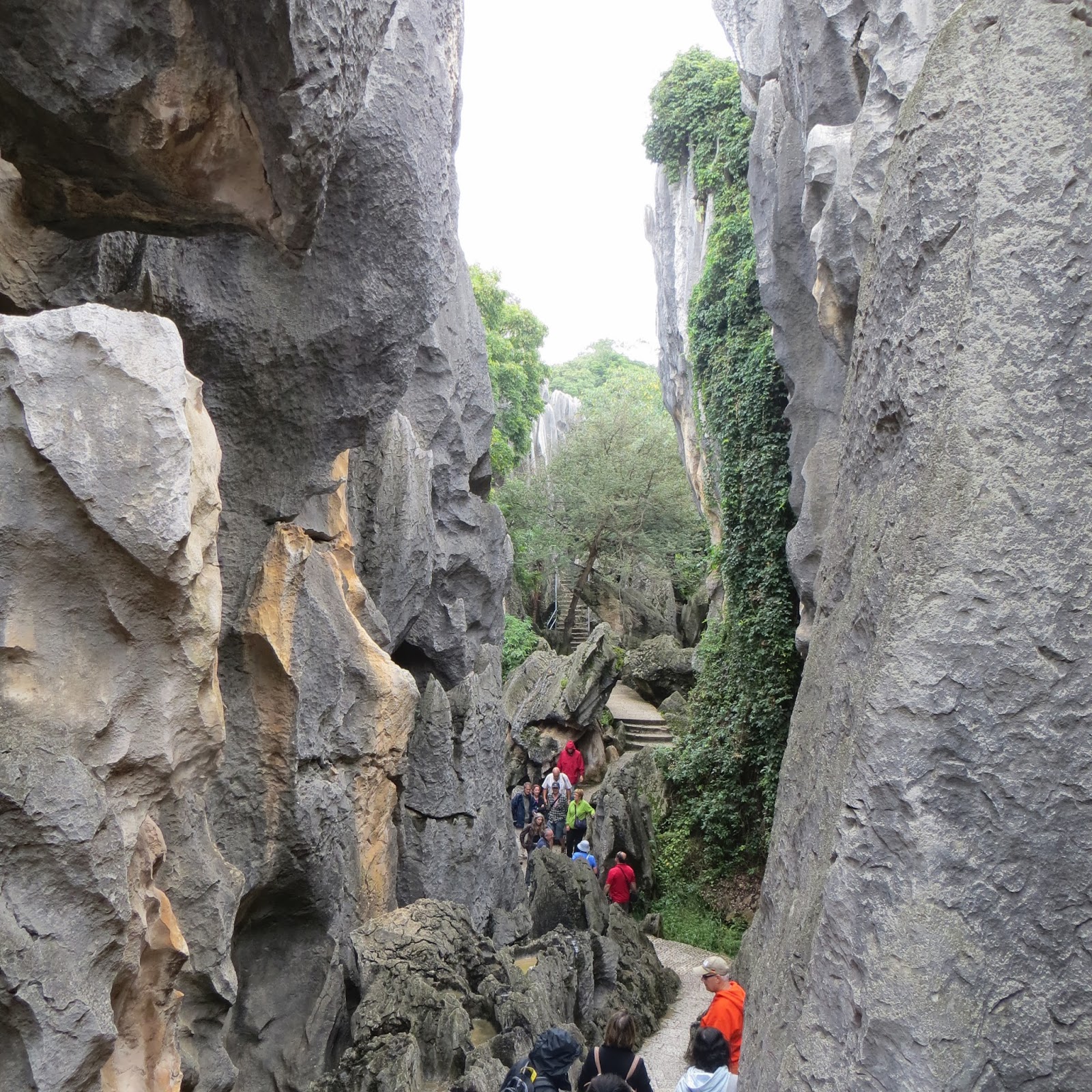
Near the city of Kunming we found ourselves in the Stone Forest surrounded by monumental stone formations in a cultivated park setting.  Deep in between the tall towers we found local musicians and dancers performing traditional music on ancient style instruments.  


I chose to paint this musician with his stringed drum instrument when he took his break.  The music was enchanting as it echoed off the stone walls.  

Here are some images of my painting in progress.

Beginning sketch
Color block in


 "Kunming Interlude"

By Vicky Gooch
16" X 12"  Oil on Linen


Wednesday, October 30, 2013

The Long View

On the shores of Erhai Lake we got caught in the rain.  Even on the water some of the traditional architecture is on display in the form of a pier. 

Legend has it that Dali near Erhai Lake was once a swamp inhabited by dragons. The dragons were believed to deliberately create natural disasters to dispel human intruders.  The Three Pagodas were built to deter the dragons around 823-840 AD.  We had a look at the ancient Three Pagodas before continuing up the foothills to the main Chongsheng Temple.

The view of Erhai Lake below from the main temple is well worth the hike even on a cloudy day.
People of all faiths come to the temple for prayer or meditation.  One lady was patiently escorting an older man slowly up the many steps and steep pathways to the main temple.  I imagine this may have been her father and he may have escorted her through many a challenge in their younger days.

"Generations of Faith"

 By Vicky Gooch
18" x 24" Oil on Linen

From Dali to Kunming to see the Stone Forest and on to Guiyang


View Dali, Yunnan in a larger map

Beauty Seen and Unseen - Vicky Gooch


We were swallowed up by the clouds on our way to the top of the Jade Dragon Snow Mountain.  We imagined great vistas beyond but could not see them with our eyes.  The air was like a cool damp blanket insisting on our silence.  We could hear the moisture dripping from the trees below with the occasional resonant clinking of the lead Yak’s bell.


Atop the mountain sits the monastery and the keepers of the Yaks.  The clouds parted just long enough to give us a little glimpse into these lives of graceful solitude before making our way back down from the mountain to visit a very special school.

We were welcomed to the school for Baisha Handmade Embroidery of the Naxi People with signs in English and Chinese explaining the history of silk embroidery and the school's mission to preserve the art.  The individual silk threads are so thin as to be nearly invisible.  Yet put together with careful trained hands, they create beautiful shimmering images on fabric.   


This is my painting of a young embroidery school student.  
“Silk Stitches”

By Vicky Gooch
16" x 12"  Oil on Linen

Best Wishes From Lijiang - Vicky Gooch

Lijiang Old Town is in a mountainous region of Yunnan Province. It has cobbled streets along waterways with small footbridges leading into traditional shops in the ancient buildings of the Naxi people. We hung a wish in a forest of wishes to celebrate our anniversary.

From around 618-1279 the Tibetan Bon Religion, Buddhism and Taoism, were introduced into this region affecting the native beliefs of the Naxi people and leading to the Dongba Religion. The Naxi Dongba script was reputedly invented by King Moubao Azong in the 13th century. It is used exclusively by the shamans or priests who are known as Dongbas as an aid to the recitation of ritual texts. Use of the Naxi language and script was discouraged after the Communist victory in 1949, and they were actively suppressed during the Cultural Revolution in the 1960s when thousands of manuscripts were destroyed. Today there are not many Dongba priests left to read and write the Dongba script. Efforts are being made to revive the script.


This is my painting of the Dongba painting his good wishes for the people.
His hands were sure and steady; his face was a picture of grace.
“Dongba Wishes for You”

By Vicky Gooch
24"x 18"  Oil on Linen

“For family, peaceful life, good health, longevity and happiness;


our best wishes for you.”

In the Shadow of a Dragon - Mary Frankel

Journal Entry: Tuesday, 9/11, Lijiang


A beautiful city bumped up against the mythical Jade Dragon Snow Mountain, and home to the Naxi nationality.  The town is lively and bustling with young people. Patagonia style shops line the square selling beautiful hand-woven items.  At night, musicians play in the second-story bars, their music drifting down into the street creating a peaceful, romantic mood.  I am suddenly reminded of Frank Capra’s movie ‘Lost Horizon’, where a group of civilians crash land in the Himalayas and are rescued by the people of the Eden-like valley of Shangri-la. I am drawn to this beautiful place and the people of Lijiang.  

"Naxi (Respectable People)"
Oil on Linen
14" x 11"
by Mary Frankel

We travel north to the Old Town of Lijiang.  We also rode gondolas up to the Jade Dragon (Yulong) Snow Mountain and visited the Dali People and the Three Pagoda Temple overlooking Erhai Lake.

A Splash of Happiness in Xishuangbanna - Mary Frankel

Journal entry Monday 9/10:  Menglun, Xishuangbanna-


“In Menglun we visited a 600 hectare tropical flowers and plants garden.  Lotus flowers, which were in abundance are a symbol of purity and love between a man and a woman.”


"We had a real treat in Menglun, where the Dai minority people were having a festival.  The New Year on the Dai Calendar is celebrated each year with a water-sprinkling festival. Splashing water on everyone is a symbol of blessing and happiness, the more water one is splashed with, the happier one will be.  The festival embodies the prayer for a timely rain and a good harvest. This all takes place in the town center fountain."

"Dai Minority, Water Splashing Festival"
By Mary Frankel


We travel from Guilin and the Li River to Xishuangbanna.

A Feast of Fruit in Xishuangbanna by Vicky Gooch

Lush.  That’s the way to describe the Tropical Botanical Garden in Xishuangbanna.  The Mekong River flows through this area of lush mountainous rain forest.  That’s me with my pack in the middle of all that green.  

The first botanists to decide that this would be the perfect place to do their research are remembered in stone.  They had the idea that they could cultivate the jungle for food and other plant based products. 


Today an area of the botanical garden is kept open for tours.  Many of the houseplants or tropical plants that we use in our own gardens were on display in a super-size!  We were treated to a feast of luscious juicy fruit before we went on our way.  It was all hand-picked and delivered to our shady picnic area via bicycle carts like the one in my painting.

“Bicycle Cart with Pomelos”
By Vicky Gooch

12” X 16” Oil on Stretched Linen

Selling Grapes on the Li River -Vicky Gooch

The Chinese people know they have something special in the Li River.  The rock formations are nothing short of amazing.  Sure, there were fishermen at work and water buffalo along the shore.  But I saw a lot more vacationers enjoying a ride or a swim. We took our ride on a big lazy tourist boat with an open deck to take in the views.  Those tall fuzzy plants along the shore are bamboo.  So the traditional boat is made of bamboo poles lashed together to form a raft.  Fisherman use them with nets on tall poles or big water birds called cormorants who dive in and retrieve the fish which goes into a basket on the raft.  Who needs a rod and reel when you can use a bird!  I think it takes a lot of skill to stay dry on a bamboo raft.
But you should get yourself to the Li River soon!  I discovered that the bamboo raft has a competitor. Check out this lovely little tourist boat on PVC pipe.  It had cozy benches, shade, cooler for your lunch and a speedy motor.  No need to stand and paddle.  Still, it didn't have the same traditional appeal.  It was missing that warm honey colored wood and those dark ribs that announce the bamboo as a living growing thing.
Whenever a big tourist boat happened along, this entrepreneur paddled his bamboo raft out to meet it.  His crate was loaded with grapes to satisfy hot tourists taking in the sights on the upper deck of the tour boats.  This was not a job for the weak or tentative.  He had to push off from the shore and paddle hard.  Then he tie his raft to the side of the bigger boat and passed his produce up to his hungry customers.
Tourism is an important business in this area of China.  I saw so many people bringing their traditional crafts and activities to share with the many tourists from urban China or farther away.  As this flow of curious visitors arrive, the local people respond.  This human connection with each other and the environs caught my attention.  This is what I wish to share with you.  Here’s a peek at the grape seller.

 Detail of “The Grape Seller”
24” X 18” Oil on Stretched Linen